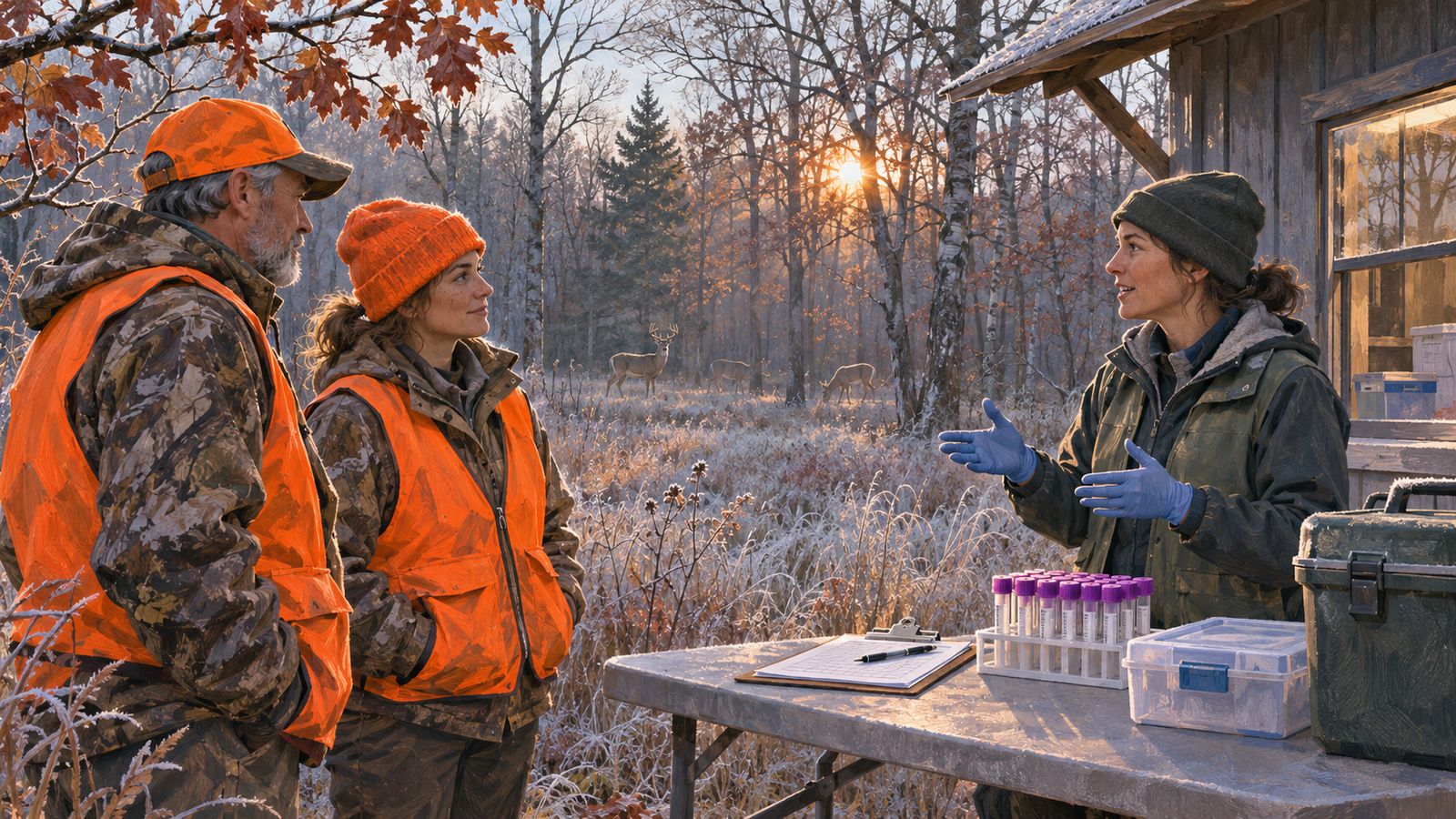
Minnesota's firearms deer season opened Saturday, November 7, and runs through November 29, Northern News Now reports. The Department of Natural Resources has started a four-year rotation for chronic wasting disease surveillance that splits the state into quadrants; this year, testing is mandatory in southwestern Minnesota for deer age 1 or older taken on opening weekend, and voluntary elsewhere. Northeastern Minnesota is not scheduled for mandatory testing until 2028.
Licenses can be bought and harvests registered online, through a mobile app or in person under the state's new electronic license system, and license sales are up this year. Deer numbers are rebounding in the northeast, especially around Duluth and parts of Itasca County, after mild winters. Wear blaze orange or blaze pink, check stands before climbing and tell someone where you are hunting. Michigan's firearms season opens November 15 and Wisconsin's November 21.
Wild River State Park in Chisago County, Minnesota, is closed to the public November 7 through 9 for a special hunt, open only to hunters drawn for permits, the Chisago County Press reports; camping and day use resume Tuesday, November 10. The park is unrelated to the Wild River Fire in New Hampshire.
noticeFirearm deer openers: MN Nov 7, MI Nov 15, WI Nov 21, PA Nov 28Minnesota · Michigan · Wisconsin · PennsylvaniaCheck zones, licenses and blaze orange rules with each statechecked Oct 27
Minnesota goes first, then Michigan on November 15, Wisconsin's nine-day hunt on November 21 and Pennsylvania on November 28. Dates and zones below; confirm the details with each state.
Minnesota's firearms deer season opens Saturday, November 7. In the 100-series permit areas, most of the north, it runs through November 22; in the 200- and 300-series areas the A season runs November 7 to 15, and the 300-series B season November 21 to 29.
Michigan's regular firearm season opens on its traditional date, November 15, and runs through November 30 statewide, in both the Upper and Lower peninsulas.
Wisconsin's ninth elk season since the animals were reintroduced opens Saturday, October 17, the Department of Natural Resources says. Sixteen state hunters were drawn from more than 34,000 resident applicants.
In the Northern Elk Management Zone the quota is eight bulls, with four licenses to state hunters and four to tribal members. In the Central Zone, six bull and six antlerless licenses went to state hunters. New this year, tags are unit-specific, so harvest can be concentrated where elk cause more conflicts with people and kept lower where the department wants the herd to grow.
The Minnesota Department of Natural Resources is taking public comment on a proposal to enroll about 57 miles of existing roads and trails in Becker County in the state's OHV grant-in-aid program. The Woods and Wheels ATV Club proposed the Ice Cracking ATV Trail, with Becker County as the local government sponsor.
No new trail would be built. Enrollment would bring state cost-share money to maintain the existing system, and the route would connect Two Inlets State Forest east toward White Earth State Forest and a wider OHV network. The grant-in-aid program is a partnership between the DNR, a local government and a local club that funds trails for ATVs, off-highway motorcycles and off-road vehicles.
Hunters in southwest Minnesota will have to get every deer a year or older that they take on the firearms deer opener, Saturday and Sunday, November 7 and 8, sampled for chronic wasting disease, the Minnesota DNR says. Mandatory sampling is new to the southwest this year.
It is the first year of a four-year rotation. The DNR has divided the state into four surveillance blocks, about a quarter of the state each: the southwest in 2026, the northwest in 2027, the northeast in 2028 and the southeast in 2029. Until now the department sampled mostly near known cases, and nearly two-thirds of the state has not had targeted surveillance in more than 20 years. Recent detections outside the existing CWD management zones prompted the change.
The Minnesota DNR wants early input, through 4:30 p.m. November 19 on an online questionnaire, on fishing rule proposals. They include matching Wisconsin's bass catch-and-release seasons on the St. Croix River; adding Perch Lake to the St. Louis River boundary-water rules, with a bass catch-and-release season and new walleye size limits; closing Musky Bay on the Mississippi and waters near electric carp barriers; opening several Otter Tail County streams and the water below Locks and Dams 3 and 4; letting the DNR close Grand Marais harbor in fall when brook trout gather there; and aligning Saganaga Lake's walleye length rules with statewide rules.
The Minnesota DNR has decided not to adopt the optional three-duck daily bag limit, it said October 8, keeping the existing six-bird structure. The department's own assessment found the option would not harm duck populations, but many hunters said the six-bird limit supports a culture of species identification, mentorship and tradition, and many were confused and thought they would be forced to a lower limit. States that opted in are part of a five-year evaluation through 2031, after which the U.S. Fish and Wildlife Service will decide whether to offer it to others.
The Wisconsin Department of Natural Resources has released an initial draft of its next Turkey Management Plan and is taking public comment through November 20 through an online comment tool. After that, staff will revise the plan and take it to the Natural Resources Board for final approval.
Open houses run 5:30 to 8 p.m., with a presentation at 6: Monday, October 12, at the DNR Service Center in La Crosse; Tuesday, October 13, at the Lincoln County Service Center in Merrill; and Wednesday, October 14, at the DNR/USDA office in Appleton. A virtual session is Thursday, October 15. Staff will explain what has changed since the last round of public input.
Michigan's Natural Resources Commission enacted changes to two fisheries orders effective September 10. One governs trout and salmon on inland lakes and clarifies possession limits to better match the fish actually present in those waters. The other aligns Michigan with Wisconsin on the catch-and-immediate-release lake sturgeon season on the Menominee River, across Dickinson, Iron and Menominee counties.
The important part for anyone heading out: these changes are not in the printed 2026 regulations. The digital version and the state's hunt-and-fish app carry the current rules; the booklet in your truck does not.
The state relaunched MiHunt, its interactive map of land open to public hunting, in time for the fall seasons. It is the tool for sorting what is actually open from what merely looks green on a road atlas, and a rebuild is worth ten minutes before you drive somewhere on last year's assumptions.