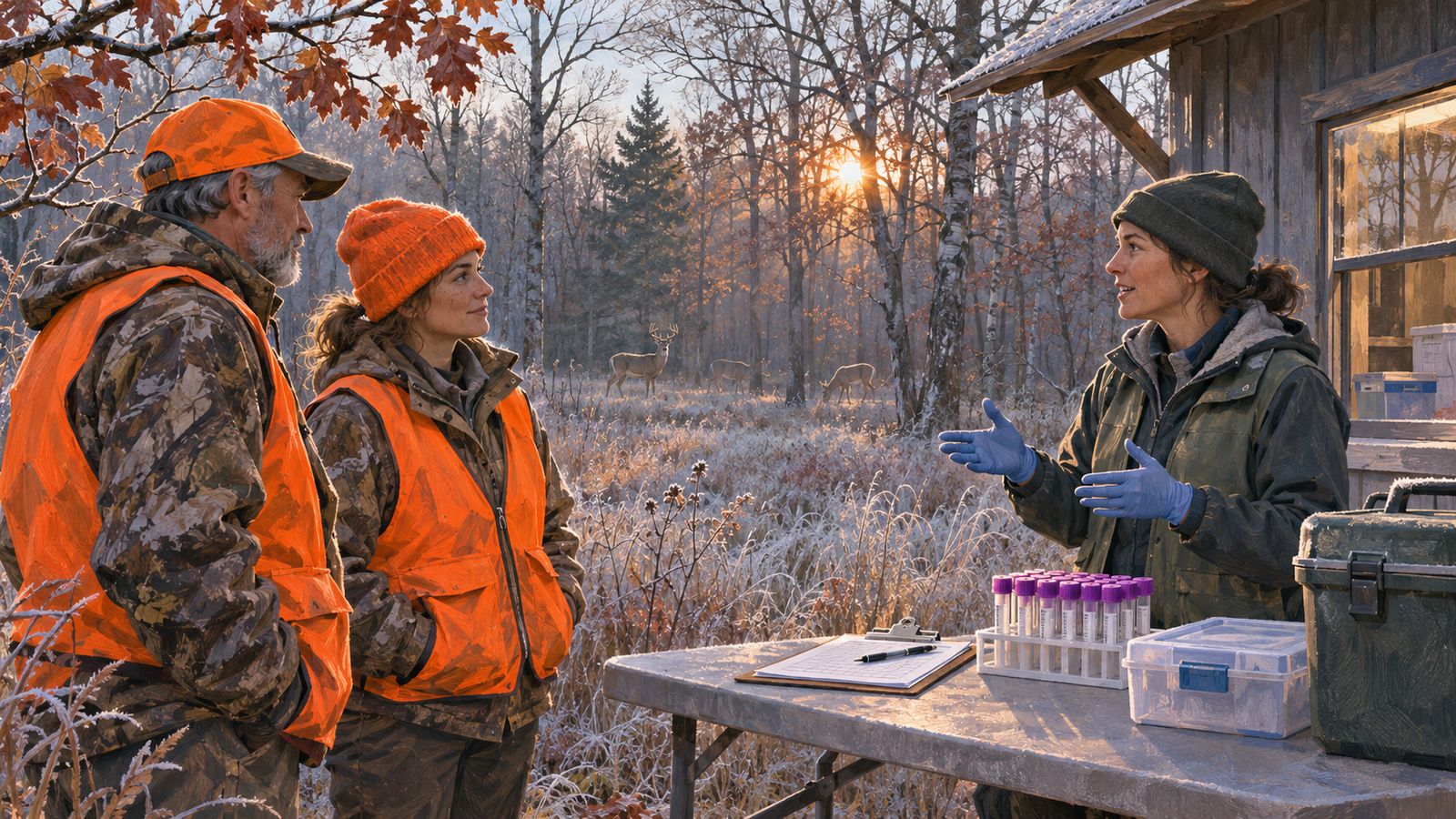
Minnesota's firearms deer season opened Saturday, November 7, and runs through November 29, Northern News Now reports. The Department of Natural Resources has started a four-year rotation for chronic wasting disease surveillance that splits the state into quadrants; this year, testing is mandatory in southwestern Minnesota for deer age 1 or older taken on opening weekend, and voluntary elsewhere. Northeastern Minnesota is not scheduled for mandatory testing until 2028.
Licenses can be bought and harvests registered online, through a mobile app or in person under the state's new electronic license system, and license sales are up this year. Deer numbers are rebounding in the northeast, especially around Duluth and parts of Itasca County, after mild winters. Wear blaze orange or blaze pink, check stands before climbing and tell someone where you are hunting. Michigan's firearms season opens November 15 and Wisconsin's November 21.
A man was gored in the face by an antler on Monday, October 26, while he and another man tried to cut a young mule deer buck free from wire on private land near Walla Walla, Washington Fish and Wildlife said. He became caught in the wire as the buck struggled and was treated at a local hospital; officers later had to put the deer down because it was too badly entangled. The department's advice: do not try to free tangled or injured wildlife yourself. Call WDFW Police at 360-902-2936, email [email protected], or call 911, and keep pets away from deer, which can seriously injure people when threatened.
noticeFirearm deer openers: MN Nov 7, MI Nov 15, WI Nov 21, PA Nov 28Minnesota · Michigan · Wisconsin · PennsylvaniaCheck zones, licenses and blaze orange rules with each statechecked Oct 27
Minnesota goes first, then Michigan on November 15, Wisconsin's nine-day hunt on November 21 and Pennsylvania on November 28. Dates and zones below; confirm the details with each state.
Minnesota's firearms deer season opens Saturday, November 7. In the 100-series permit areas, most of the north, it runs through November 22; in the 200- and 300-series areas the A season runs November 7 to 15, and the 300-series B season November 21 to 29.
Michigan's regular firearm season opens on its traditional date, November 15, and runs through November 30 statewide, in both the Upper and Lower peninsulas.
Wisconsin's nine-day gun deer season runs November 21 to 29, followed by the muzzleloader season.
Pennsylvania's regular firearms season opens Saturday, November 28, and runs through December 13.
Every state sets its own rules on antlerless tags, permit areas, legal firearms, chronic wasting disease testing and carcass movement, and some changed this year; read the current regulations before you go. All four require hunters to wear blaze orange during firearm seasons, some also allow blaze pink, and the required amount varies by state. These dates are compiled from the states' published season calendars; check the agency page for your zone.
Vermont's four-day muzzleloader season for antlerless deer runs October 29 through November 1 and is open only to hunters who received an antlerless permit; a hunting license and muzzleloader license are also required. The permit can be used now, in the November 14 to 29 regular season or in the November 30 to December 13 muzzleloader season, for one antlerless deer. Report a deer within 48 hours online, with photos, or at a big game reporting station, and field-dress it before reporting.
A woman was injured by a black bear on Sunday, October 18, on a rural property outside Cusick in Pend Oreille County, Washington, the Department of Fish and Wildlife said. She was treated at a local hospital and then transferred to a hospital in Spokane.
The afternoon before, her husband had been lawfully hunting black bear on their private property off Reynolds Creek Road and shot a bear with a crossbow; it ran off. The couple went looking for it the next morning with their dog. The bear chased the dog and attacked the woman, and the couple drove straight to the hospital.
Fish and Wildlife officers, a Forest Service officer and a Kalispel Tribal officer found a bear near the site with the help of dogs that afternoon, and a WDFW officer killed it because of the attack and its injuries. It was sent to the state's animal disease lab in Pullman for evaluation.
Attacks are rare. Washington's only recorded fatal black bear attack was in 1974, and the state has documented a little over 20 injuries from black bear encounters since 1970. For any bear encounter, the department's advice is to identify yourself as human by standing tall, waving your arms and talking in a low voice, and to back away slowly without running.
New Mexico closed Bear Management Zone 1 to hunting on October 16 after its harvest limit was reached. With Zones 2, 3, 9, 10 and 12 already closed, six zones are now shut. Confirm a zone is open before every hunt on the Department of Wildlife's website or the Bear and Cougar Closure and Harvest Hotline, 877-950-5466.
noticeProposed rules: CWD zone carcass movement; e-tagging for game birdsStatewide, IdahoComments through Oct 28; commission vote Nov 17–18checked Oct 14
Idaho Fish and Game is taking public comment through October 28 on two proposed rules, one of which would change what hunters can do with a deer, elk or moose taken inside a chronic wasting disease management zone.
Today, whole carcasses, which may still contain brain or spinal tissue, can be moved between game management units within a CWD management zone. The proposal would let the department manage those zones unit by unit and make it illegal to move a carcass from one unit to another inside a zone, whether the animal was hunted or salvaged.
The second proposal would explore extending electronic tagging to certain game birds, so hunters who choose it would no longer need a paper tag in the field, which the department says would avoid faded, washed-out or lost tags. E-tagging would be optional.
Staff will present the comments and their recommendations to the Fish and Game Commission, which is scheduled to vote at its November 17–18 meeting. If approved, the rules become pending. Comment forms for both are linked from the department's release.
Texas quail season opens November 1, and the state's August roadside surveys point to good numbers, Texas Parks and Wildlife says. Biologists drove more than 3,300 miles of survey routes, and most ecoregions counted more bobwhites per route than their 15-year average, helped by good habitat and timely rain despite a hot, dry summer.
South Texas averaged 10.17 bobwhites per route, above its 15-year mean of 9.92, after multiple successful hatches; the Chaparral and James E. Daughtrey wildlife management areas offer public hunting there. The Rolling Plains came in slightly lower than last year but should still hunt well, with public bobwhite hunting on the Matador, Gene Howe and Teacup Mountain WMAs. Teacup Mountain is a relatively new 11,091-acre area being managed in part for bobwhites.
Scaled quail continued an upward trend, beating the 15-year average in most ecoregions, with late spring rain giving nesting a boost in the Trans-Pecos and Edwards Plateau. The department expects South Texas and the Trans-Pecos, traditionally the strongest regions, to be best.
Wisconsin's ninth elk season since the animals were reintroduced opens Saturday, October 17, the Department of Natural Resources says. Sixteen state hunters were drawn from more than 34,000 resident applicants.
In the Northern Elk Management Zone the quota is eight bulls, with four licenses to state hunters and four to tribal members. In the Central Zone, six bull and six antlerless licenses went to state hunters. New this year, tags are unit-specific, so harvest can be concentrated where elk cause more conflicts with people and kept lower where the department wants the herd to grow.
Seven dollars of every $10 application goes to elk management, and the program is nearly self-funded. Applications for the 2027 hunt are expected to open March 1 and run through May 31, 2027, for units with a harvest quota.
Arizona Game and Fish is warning hunters that the Rough Rider, a three-day gravel bike race, runs October 30 through November 1 in the Prescott area, on the second weekend of the general deer hunt. Riders will be in the Camp Wood area in Units 17A and 17B on Friday, the Mt. Union area of the Bradshaw Mountains in 20A on Saturday, and Copper Basin and Skull Valley in 20A and 17B on Sunday. Route maps are on the race's website; the department asks hunters and cyclists to be aware of each other.
Hunters in southwest Minnesota will have to get every deer a year or older that they take on the firearms deer opener, Saturday and Sunday, November 7 and 8, sampled for chronic wasting disease, the Minnesota DNR says. Mandatory sampling is new to the southwest this year.
It is the first year of a four-year rotation. The DNR has divided the state into four surveillance blocks, about a quarter of the state each: the southwest in 2026, the northwest in 2027, the northeast in 2028 and the southeast in 2029. Until now the department sampled mostly near known cases, and nearly two-thirds of the state has not had targeted surveillance in more than 20 years. Recent detections outside the existing CWD management zones prompted the change.
Hunters can get deer tested at staffed or self-service sampling stations, among other options listed by the DNR. Check the surveillance block map before the opener to see whether your hunting area is inside it.
New Mexico closed Bear Management Zone 10 to hunting on October 9 after its harvest limit was reached, the Department of Wildlife says. Zones 2, 3, 9, 10 and 12 are now closed and all others remain open. Hunters must confirm a zone is open before every hunt, on the department's website or the Bear and Cougar Closure and Harvest Hotline, 877-950-5466.
Idaho's resident pheasant season opens October 15 everywhere in the state this year, rather than on different dates in the north and south, Idaho Fish and Game said. Nonresidents start October 20. The daily bag limit is now three roosters, no more than two of them from Upland Game Bird Permit release areas. The youth pheasant hunt, for licensed hunters 17 and younger, runs October 8 through 14.
The department is stocking nearly 29,000 pheasants at 24 release sites in every region. On those sites, hunters 18 and older need an Upland Game Bird Permit, which covers six birds and must be notched and dated in ink for each one taken; the daily limit there is two, with six in possession. Shooting hours on release sites start at 10 a.m., except in the Clearwater Region, where they start at 8 a.m. and online sign-up is required.
All upland bird hunters must wear at least 36 square inches of hunter orange above the waist during pheasant season. Release sites are on the department's Pheasant Stocking Program page.
The Minnesota DNR has decided not to adopt the optional three-duck daily bag limit, it said October 8, keeping the existing six-bird structure. The department's own assessment found the option would not harm duck populations, but many hunters said the six-bird limit supports a culture of species identification, mentorship and tradition, and many were confused and thought they would be forced to a lower limit. States that opted in are part of a five-year evaluation through 2031, after which the U.S. Fish and Wildlife Service will decide whether to offer it to others.
Texas hunters should see good harvest numbers and a fair shot at quality bucks this season, Texas Parks and Wildlife says. After three straight years of above-average fawn survival, the state's white-tailed deer population is estimated at 5.64 million.
Late-spring and early-summer rain rescued habitat across most of the state. The department expects slightly above-average antler quality in most regions, with the Cross Timbers, Edwards Plateau, Eastern Rolling Plains and parts of the Post Oak Savannah and Blackland Prairie doing best. Pockets of South Texas and the Pineywoods missed the spring rain and should expect average antlers. The Edwards Plateau has the most deer, about 1.97 million, with the highest density around Llano and Mason counties, where the department says doe harvest is especially important. For mature bucks, South Texas and the Western Rolling Plains typically produce the largest.
The new concern is New World screwworm, a parasite confirmed in Texas earlier this year that hit the state's white-tailed deer hard in the early 1900s. The department asks hunters to watch for signs of infestation on trail cameras and in the field, to inspect harvested deer, and to report anything suspicious to their local TPWD biologist promptly. Its screwworm page explains what to look for.
Chronic wasting disease rules also apply: check the season dates, bag limits and carcass disposal rules for your county in the Outdoor Annual app before you go.
Two residents of the Sunset Heights subdivision in Salmon, Idaho, were injured early October 2 when a juvenile black bear tried to get in their back door around 3:30 a.m., Idaho Fish and Game said. They tackled and wrestled the bear. One was flown to Eastern Idaho Regional Medical Center in Idaho Falls.
The sow was shot by a neighbor shortly after the attack, and both juveniles were trapped the next morning and euthanized. Fish and Game had been told the day before that a sow with cubs was killing chickens there and had set traps on the neighboring property. Investigators found the bears had been feeding for several days on a large pile of unsecured household garbage outside the home.
The department's warning applies well beyond Salmon. Drought and poor natural food are driving bears closer to people as they fatten for winter, and it lists garbage, leftovers, pet food and uncleaned barbecues and smokers left outside as attractants. Food-conditioned bears quickly lose their wariness. Report bears around homes early to the local Fish and Game office, so staff can work with residents to deter them before they become food-conditioned.
The California Department of Fish and Wildlife has released a draft Bobcat Conservation and Management Plan, the first in the state's history, and is taking written comments through November 1. Bobcat hunting and trapping have been illegal in California since 2020 except under limited circumstances such as a depredation permit, and that law requires a plan like this before a season can even be considered.
Five years of study found bobcats throughout the state with a stable population of more than 62,000, similar to the department's estimates from 1977 and 1981. The 133-page draft lists vehicle strikes and disease, especially mange, as the leading known causes of death.
Only the Fish and Game Commission can reinstate a season; the plan is meant to give it current science and possible management options. Comments go to [email protected] with "California Bobcat Conservation and Management Plan" in the subject line, or by mail to CDFW Wildlife Branch, Attn: Rachel Roberts, P.O. Box 944209, Sacramento, CA 94244-2090.
The Wisconsin Department of Natural Resources has released an initial draft of its next Turkey Management Plan and is taking public comment through November 20 through an online comment tool. After that, staff will revise the plan and take it to the Natural Resources Board for final approval.
Open houses run 5:30 to 8 p.m., with a presentation at 6: Monday, October 12, at the DNR Service Center in La Crosse; Tuesday, October 13, at the Lincoln County Service Center in Merrill; and Wednesday, October 14, at the DNR/USDA office in Appleton. A virtual session is Thursday, October 15. Staff will explain what has changed since the last round of public input.
Montana's pheasant season opens Saturday, October 10. Montana Fish, Wildlife and Parks plans to release more than 15,000 pheasants across the state this fall, including more than 3,500 this week, under its Roosters for Recruitment program, now in its sixth year. The program is aimed at giving new hunters a better chance of success.
Nonresident upland bird hunters who plan to hunt public land, or private land enrolled in FWP's access programs such as Block Management, have to wait until October 20 for most upland species.
A map and list of release sites is on FWP's Roosters for Recruitment page, and the 2026 upland game bird regulations have the rest of the rules.
The New Mexico Department of Game and Fish is asking elk hunters in Game Management Unit 34 to bring in the heads of their animals for chronic wasting disease testing. CWD has been found in the unit before, and the department wants to see how far it has spread.
A collection station will run October 17 through 21 at the intersection of the Sunspot Highway and the Cox Canyon Highway, State Road 130. Bring the head in within 48 hours of the kill; keeping it cold or on ice, but not frozen, can stretch that window. Testing is voluntary, and hunters who take part are entered in a draw for an elk or oryx authorization.
What is not voluntary is the carcass rule. In GMU 34 you may take out only cut and wrapped or boned-out meat, quarters with no part of the head or spine attached, hides without heads, clean skull plates with antlers, antlers with no tissue, elk ivories, and heads finished by a taxidermist.
CWD is a fatal prion disease of deer, elk and moose. No human cases have been reported, but public health officials advise against eating meat from an infected animal. The department asks hunters to pass this on to anyone holding a 2026–27 deer or elk tag in the unit.
More than 1,450 new hunting and fishing opportunities across 32 states. Buried in the same rule: non-lead requirements at nine refuges, rescinded weeks before they took effect.
The Fish and Wildlife Service published its 2026-2027 station-specific hunting and sport fishing rule in the Federal Register on September 1. It opens or expands more than 1,450 opportunities at 111 field stations — 107 refuges and four national fish hatcheries — across 32 states. Interior describes it as the largest expansion of hunting and fishing access in the agency's history, and on the access question alone it is hard to argue with.
The part that has not travelled as far is the lead provision. Non-lead ammunition and tackle requirements that had been finalised for nine refuges, and that were due to take effect on September 1, were rescinded by the same rule. Those phase-outs covered Blackwater, Chincoteague, Eastern Neck, Erie, Great Thicket, Patuxent Research, Rachel Carson and Wallops Island among others, and they came out of a 2021 lawsuit settled in 2022.
Attorneys at Earthjustice and the Center for Biological Diversity have both signalled they are looking at litigation. This is the third round of the same fight: a service-wide lead ban issued at the end of one administration in 2017 was reversed weeks later by the next, and the phase-outs now being rescinded were themselves the product of a court settlement. Expect it back in front of a judge.
An opportunity in this rulemaking is not the same as a refuge opening wide. Each entry is station-specific and species-specific, and the actual conditions live in the station rules rather than the headline count. Read the entry for the unit you intend to hunt.
Worth holding alongside the access number: agency staffing fell by roughly 18 percent between April 2024 and May 2025. More opportunities on paper depend on people on the ground to maintain trails, monitor impacts and enforce the rules.
National Hunting and Fishing Day falls on Saturday September 26, the same day as National Public Lands Day. State agencies run free family events for it, and they are more substantial than the name suggests: North Carolina is opening its hunter education complex with free muzzleloader, shotgun and rifle ranges, firearms and ammunition provided, plus archery, a skills trail and a falconry demonstration. West Virginia's event at Stonewall runs game butchering and wild game cooking demonstrations. If you have been meaning to get someone started, a day with free ranges and borrowed equipment is a cheaper introduction than a licence and a rifle.
Work out where your sample goes before you leave home. Options vary by state and region: staffed check stations on firearm-season weekends, self-serve kiosks, agency offices during posted hours, and participating taxidermists. Coverage is not uniform, and more than one state says plainly that you may have to drive to a neighbouring community. Build that drive into the plan rather than discovering it on a Sunday afternoon.
Know the carcass transport rule for the unit, because it governs how you break the animal down in the field. Inside a management zone you generally cannot move a whole carcass out. Heads or lymph nodes going to the agency for sampling are the standard exception, and antlers or skull caps can usually be retained after sampling, with the rest of the head staying for disposal.
Submitting a sample does not satisfy harvest reporting. They are separate obligations with separate deadlines, and missing the reporting one is the easier mistake to make. Some states want a report inside 48 hours.
Check the prerequisites that sit in front of the license. A black bear identification test is required before purchase in some states. Region-by-region rules differ inside a single state: one region may want a tooth submitted while others require hide and skull inspection within ten days.
The general principle behind all of it: read the proclamation for the unit you actually drew rather than the one you hunted last year. Four states changed their requirements this season alone.
The state relaunched MiHunt, its interactive map of land open to public hunting, in time for the fall seasons. It is the tool for sorting what is actually open from what merely looks green on a road atlas, and a rebuild is worth ten minutes before you drive somewhere on last year's assumptions.
Archery opened September 5, wolves and black bears came in on the 15th, and the commission changed how lions and hounds are handled.
Opening dates stagger by species. Shoulder seasons are a district tool, not a statewide extension. Outdoor Unc · dates from the sources below; districts vary
Montana's fall is underway. Mountain grouse, partridge, sharp-tailed grouse and turkey opened at the start of the month. Archery hunters could pursue elk, deer, black bears, wolves and mountain lions from September 5, and holders of drawn bighorn, moose and goat permits started the same day.
General firearms dates stagger by species. Black bears and wolves came open on September 15. The youth deer hunt runs October 15 and 16. General deer and elk open October 24 and run to November 29, with district-specific shoulder seasons stretching as wide as August 15 to February 15 where the agency has opened them.
The rules themselves moved. The Fish and Wildlife Commission set two years of regulations last December after a summer of public meetings, responding to pressure over nonresident hunting and mule deer numbers. Mountain lion licensing was consolidated into a single license, the winter season was reset to December 1 through May 25, and hunting lions with hounds is now prohibited in occupied grizzly habitat after April 14.
Hound hunting boundaries in Region 2 were redrawn to mirror the occupied grizzly polygon, and the hound season was extended to June 15 to line up with the end of hound training. On the elk side, the 799-20 license quota went from 280 to 325, and a second antlerless B license became available to permit holders in three districts.
Housekeeping that catches people out: the black bear identification test is required before you can buy the license, harvest must be reported within 48 hours, Region 1 uses tooth submission while Regions 2 through 7 want hide and skull inspection within ten days, and many mule deer B licenses are now private-land only. Read the district notes, not the summary.
Chronic wasting disease keeps rewriting the fine print. Colorado now requires heads from every elk taken during rifle seasons in selected hunt codes, at no charge, and has dropped mandatory deer testing entirely for 2026. Hunters who want a deer tested anyway can submit voluntarily for $25.
Idaho requires testing for deer in seven units, adding 64 and 69 near Idaho Falls while removing 24 and 32A after two consecutive years with no detections. Units 14 and 18 and part of Unit 1 remain management zones, where testing is mandatory and whole carcasses may not leave the zone at all.
Delaware confirmed its first case this spring and adopted emergency regulations in August, ahead of a September 1 opener, setting up a management zone and expanding sampling. Washington has confirmed eight deer since 2024 in Spokane and Pend Oreille counties and is holding its 2025 rules in place for the 100-series units.
The practical version: read the proclamation for the unit you actually drew, not the one you hunted last year, and build travel time into the plan for reaching a check station, a self-serve kiosk or a participating taxidermist. Submitting a sample does not satisfy harvest reporting, which is a separate obligation.
Idaho biologists also flag a very dry year in the Clearwater region and ask hunters to track active fires and take care with anything that throws a spark.
The short answer to the question everyone asks first is no: the July proposal does not open a grizzly hunt, and will not soon. The bears stay federally threatened. What moves is who handles day-to-day management of roughly 2,000 animals across Wyoming, Montana, Idaho and Washington.
About half of those bears live in the Greater Yellowstone ecosystem, where populations have met recovery targets on most biological measures. That is the basis on which three states have pressed for delisting for a decade, and the basis on which two previous delistings were overturned in court.
The tiered structure is the part worth reading closely. Flexibility is tied to a state adopting conservation strategies and management plans and hitting demographic objectives, which means the practical rules in a given unit could diverge between states over the next few years rather than moving together.
The premise behind it is that reducing livestock and human conflict is itself conservation, because tolerance is what keeps bears on the landscape. Whether that holds is the argument, and the comment period is where it gets had.