Vol. I  ·  No. 64
Sunday, November 15, 2026  · 
🔍 Search  ·  353 stories in the archive

Front page › Back issues › Friday, November 13, 2026

Friday, November 13, 2026

10 stories in this edition

Off-road

Watch: Trails Offroad runs Hunter Lake above Reno

A trail video from Trails Offroad near Reno, Nevada.

Trails Offroad, Hunter Lake, Reno, Nevada offroad trail (Nov. 12). Trails Offroad on YouTube

Trails Offroad drives the Hunter Lake trail near Reno, Nevada. Check the land agency's current conditions before going; high routes in the Sierra can close with snow this time of year.

Videos play from the creator's own YouTube channel. Outdoor Unc does not take payment to feature a video.

Sources

Hunting

Watch: Eastmans' on loading an elk quarter into a pack

A short gear tip from Eastmans' Hunting Journals for the pack-out.

Eastmans' Hunting Journals, Eberlestock Brute: The Right Way to Load an Elk Quarter (Nov. 12). Eastmans' Hunting Journals on YouTube

Eastmans' Hunting Journals shows how it loads an elk quarter into an Eberlestock Brute pack.

Videos play from the creator's own YouTube channel. Outdoor Unc does not take payment to feature a video.

Sources

BBQ

Watch: two pitmasters on smoking the Thanksgiving turkey

Meat Church BBQ and Hey Grill Hey on turkey, two weeks before Thanksgiving.

Meat Church BBQ, The Best Turkey That I Have Ever Made (Nov. 11). Meat Church BBQ on YouTube

Meat Church BBQ cooks what he calls his best turkey yet, and Hey Grill Hey shares five tips for keeping the bird moist. Thanksgiving is November 26.

Videos play from the creator's own YouTube channel. Outdoor Unc does not take payment to feature a video.

Sources

advisory Cummins Onan P5000iDF EFI dual-fuel portable generatorsNationwideAbout 2,960 units sold May 2025–Aug 2026; stop using; free repair at authorized Cummins service locations (CPSC 27-087, Nov 12)checked Nov 13

Gear

Cummins Recalls Onan Dual-Fuel Portable Generators Over Fuel Spray

About 2,960 P5000iDF EFI generators sold at Camping World and elsewhere can spit gasoline or eject the fuel cap.

Cummins is recalling about 2,960 Onan P5000iDF EFI dual-fuel portable generators because valves were installed incorrectly, so fuel vapors do not vent properly from the gasoline tank, the U.S. Consumer Product Safety Commission said November 12. Pressure can build up and push fuel out or make the fuel cap pop off, a fire and burn hazard.

The company has received 11 reports of fuel discharging or caps ejecting unexpectedly. In one, a person was splashed in the face with fuel and did not need medical attention.

The generators are dark gray, run on gasoline or propane and produce 4,500 to 5,000 watts depending on the fuel, with "Cummins" printed in white on the front and handle. The model and part number are on a label on the side. They were sold at Camping World, Factory Pure, Northern Tool, AP Electric and on Cummins.com from May 2025 through August 2026 for $1,640 to $1,930.

Owners should stop using the generator, check the model and part number on Cummins' recall page and, if it is included, take it to an authorized Cummins service location for a free repair. Cummins can be reached at 800-286-6467 on weekdays.

Sources

closed Trail Ridge Road (U.S. 34), through travelRocky Mountain National Park, Larimer and Grand Co., ColoradoClosed for winter Nov 13 between Many Parks Curve (east) and Colorado River Trailhead (west); open to walkers, bikes and leashed pets on the roadchecked Nov 13

Trail reports

Trail Ridge Road Closes to Through Traffic for the Winter

Rocky Mountain National Park shut U.S. 34 between Many Parks Curve and the Colorado River Trailhead on Friday; it usually reopens in late May.

Rocky Mountain National Park closed Trail Ridge Road, U.S. Highway 34, to through vehicle travel for the winter on Friday, November 13, the park said. The gates are at Many Parks Curve on the east side and the Colorado River Trailhead on the west side.

The closed section stays open to people on foot, bicyclists and leashed pets. Bikes and pets must stay on the road itself, not on side trails or the tundra. The park warns that the road "is not designed as an all-season road."

Below the gates, Trail Ridge Road stays open on the east side to Hidden Valley and Many Parks Curve, and on the west side from the Grand Lake Entrance to the Colorado River Trailhead. Bear Lake Road and Endovalley Road also remain open.

The road typically reopens to through travel in the last week of May, weather permitting. This year it opened on May 29.

The park's recorded road status line is (970) 586-1222, available around the clock.

Sources

Field Notes

A Kit Is Not a Plan: Run the Scenarios Before You Need Them

Supplies are half of it. The other half is sitting down and asking what happens when the backup fails, the battery dies or the person who knows how is not home.

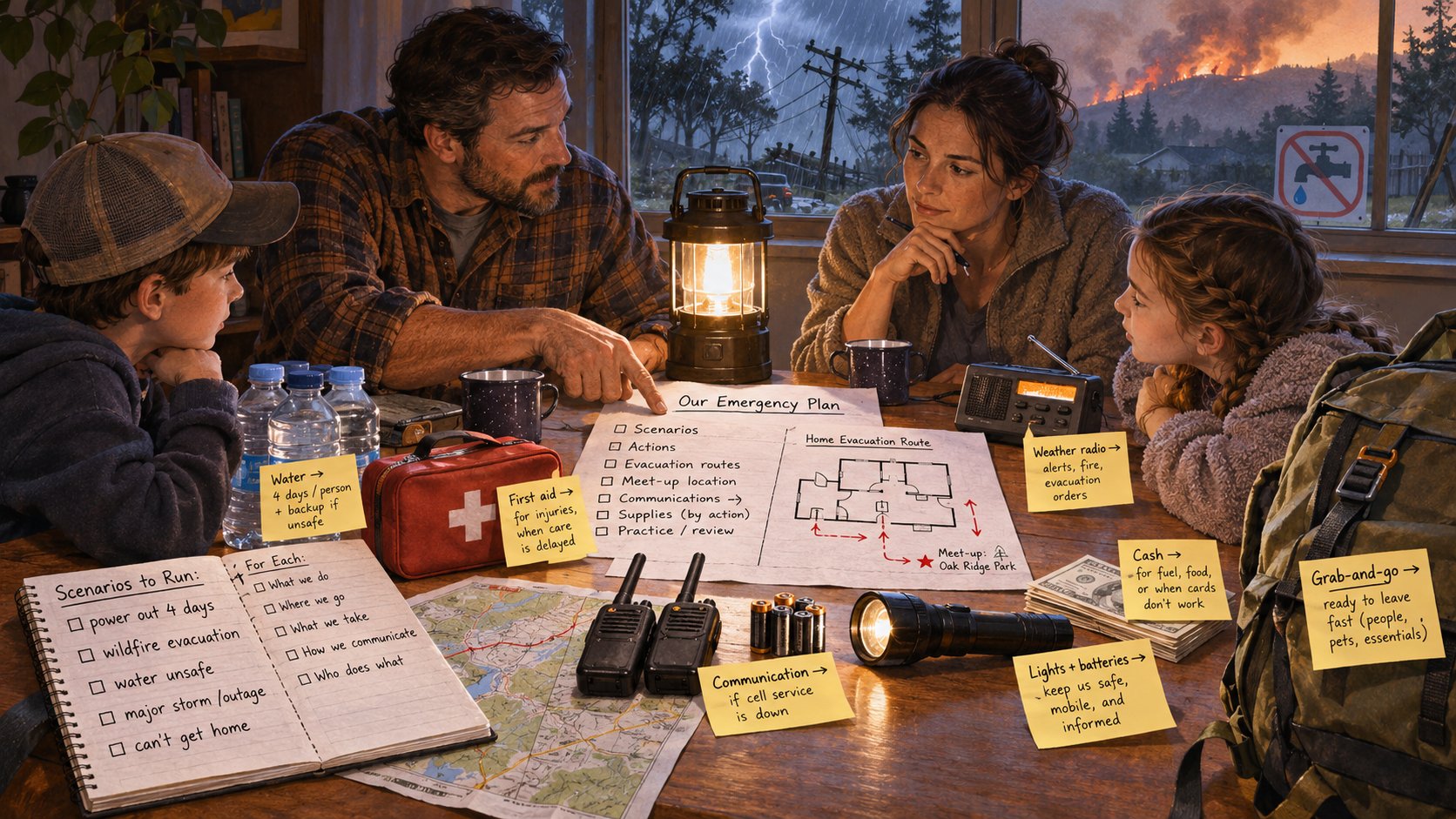
Painted illustration of a family at a lantern-lit table going over an emergency plan, with a scenario notebook, home evacuation map, first aid kit, water, radios, flashlight, cash and a go-bag, as a storm and a wildfire show through the windows.
AI-generated editorial illustration of a family running through its emergency plan. Illustration

Last month's Field Notes was about the supplies: water jugs, canned food, a grab-and-go bag. This one is about what comes next, and it costs nothing. Preparedness is not just owning the gear. It is walking through how you would actually use it, on a bad day, with the power out and half the household somewhere else, and finding the holes while it is still calm.

The method is simple. Pick a scenario. Say it out loud: the power is out for four days in January. A wildfire warning gives us fifteen minutes. The water company says not to drink from the tap. Then go down the list of what you are counting on and ask one question about each item: what if this does not work? Most plans fail at an assumption nobody noticed they were making.

Take water. A backyard pool looks like thousands of gallons of insurance, and for some jobs it is. Pool water can flush toilets, wash hands and clean up. But it is not drinking water. The CDC says to use pool water for swimming, not drinking: the chlorine, stabilizers and algaecides that keep it clear are not meant to be swallowed, and the water collects whatever blows into it. Now run it further. A wildfire drops ash in it. A chemical spill or a radiation release puts contamination on everything outdoors, and the CDC notes that boiling water does not remove radioactive material; until water is tested, sealed bottled water is the only supply known to be clean. That is the point of the exercise. The pool is a backup for washing, not a reason to skip the cases of drinking water in the garage.

Do the same with every source you are counting on. If you have a well, the pump almost certainly runs on electricity. A water heater holds clean water, but do you know where the drain valve is, and do you have to shut off the gas or power to it first? Gas stations need electricity to pump, so the generator plan depends on fuel you already have, stored safely and rotated. Card readers and ATMs go down with the grid, so the cash in the bag matters. Cell towers have limited backup power and get overloaded in a disaster, so the plan that starts with call each other may stall at step one.

Then look at the house itself. If the garage door opener has no power, does everyone know how to pull the manual release, and can they lift the door? If someone in the house takes a medication that needs refrigeration, how long does it last, and where is the cooler? If you heat with a generator or a camp stove, the carbon monoxide risk goes up: Ready.gov says to keep generators outdoors and away from windows, never in a garage, and to put battery-backed carbon monoxide alarms on every level of the home. If the plan is to drive out, is there a second route if the first is closed, and is the tank kept above half when fire season or a storm is coming?

Now the people. It is easy to build a plan around one person who knows where everything is and how it works. Ask what happens if that person is at work, stuck on a closed highway or hurt. Everyone old enough should know where the water and food are, where the gas and water shutoffs are, how to start the generator and where the bag is. If kids are at school, know the school's plan; in some emergencies, including a radiation release, officials tell parents not to go get them, because staying inside is safer than being out on the road.

The same thinking applies if you keep a firearm for home defense. Owning one is a start, not a plan. Have you practiced at a range recently, and have you done dry-fire practice at home, with the gun confirmed unloaded and no ammunition in the room? Has your spouse or partner practiced too, so they can safely handle it if you are not there or cannot get to it? Run the full sequence the way it would actually happen: woken up at 3 a.m., in the dark, getting to the safe, opening it, and doing it while managing kids or a phone call to 911. If the safe is a keypad or fingerprint model, when did you last change the battery, and does everyone who needs to know the code or have the backup key? Know what is behind every wall in the house, because a round that misses keeps going. And keep it locked whenever it is not in your direct control. Project ChildSafe, a program of the firearms industry trade group, has storage options and free cable locks through local law enforcement.

Communication is where a written plan earns its keep. Family Radio Service walkie-talkies need no license and share 22 channels with GMRS, which does need an FCC license for its higher-power use. Batteries are the limit, so do not leave radios on all day. Agree on a primary channel and a backup channel in case the first one is busy. Set check-in times: for example, radios on for ten minutes at the top of the hour at 8 a.m., noon and 6 p.m. Decide how many days that schedule holds and what it switches to as batteries run low, maybe once a day at noon. Write the channels, the times and an out-of-area contact on a card in every bag and every car, because nobody remembers channel numbers under stress. Test it once on an ordinary weekend to see how far the radios actually reach in your neighborhood.

Run the big scenarios too, even the ones that feel far-fetched. A long grid outage. A major earthquake. An attack or a nuclear incident. You do not need a bunker for these to be worth thinking about. Federal guidance for a radiation emergency is three steps: get inside, stay inside, stay tuned, ideally in a basement or the middle of a sturdy building, for at least 24 hours unless officials say otherwise. Thinking it through now tells you which room you would use, whether you have a battery or hand-crank radio to hear instructions, and whether there is enough water inside the house rather than in the backyard.

A good way to start is a tabletop drill. Sit down for half an hour with whoever lives in the house and talk through one scenario start to finish. Write down every point where someone says we would just. Those are the holes. Fix one or two, then pick a different scenario next month. Once a year, try a lights-off evening: flip the main breaker, or just do not use anything that plugs in, and see what you reach for that is not there.

None of this is about expecting disaster. It is the same habit anyone who spends time outside already has: checking the weather, telling someone your route, carrying the extra layer. You do it so the day goes fine. A shelf of supplies is a good start. Knowing what you will do with it, who does what and what to try when the first plan fails is what makes it a plan.

Sources

closed Tioga Road and Glacier Point Road, temporarily closed for snowYosemite National Park, CaliforniaClosed from 5 p.m. Thu, Nov 12, ahead of the storm; call 209-372-0200 for updateschecked Nov 13

Trail reports

Yosemite's Tioga and Glacier Point Roads Close Again for Snow

Yosemite reopened Tioga Road and Glacier Point Road after the early-November snow, then closed both again at 5 p.m. Thursday, November 12, because of the forecast for this weekend's Sierra storm, the park's conditions page shows. The park calls the closures temporary and has not announced a seasonal closure for either road. Elsewhere in the park, the trail to the top of Chilnualna Falls near Wawona has reopened, but the area east of Wawona Road and south of Glacier Point Road, out to the Bridalveil Creek trailhead, remains closed. For road status and chain controls, call 209-372-0200 (press 1, then 1) before you drive.

Sources

advisory High Surf Warnings, breaking waves to 30–40 ftClatsop to Curry Co., Oregon · Del Norte to San Luis Obispo and Santa Barbara Co., CaliforniaDel Norte, SW Humboldt, Mendocino 30–40 ft until 4 a.m. Sun; Oregon 30–35 ft (north coast until noon Sat, south until 10 p.m. Sat); SLO and Santa Barbara 18 ft+ until 3 a.m. Sunchecked Nov 13

Surfing

Surf Forecast Raised to 40 Feet on the Far Northern California Coast

High Surf Warnings now reach from Oregon's north coast to Santa Barbara County as the swell peaks late Friday into Saturday.

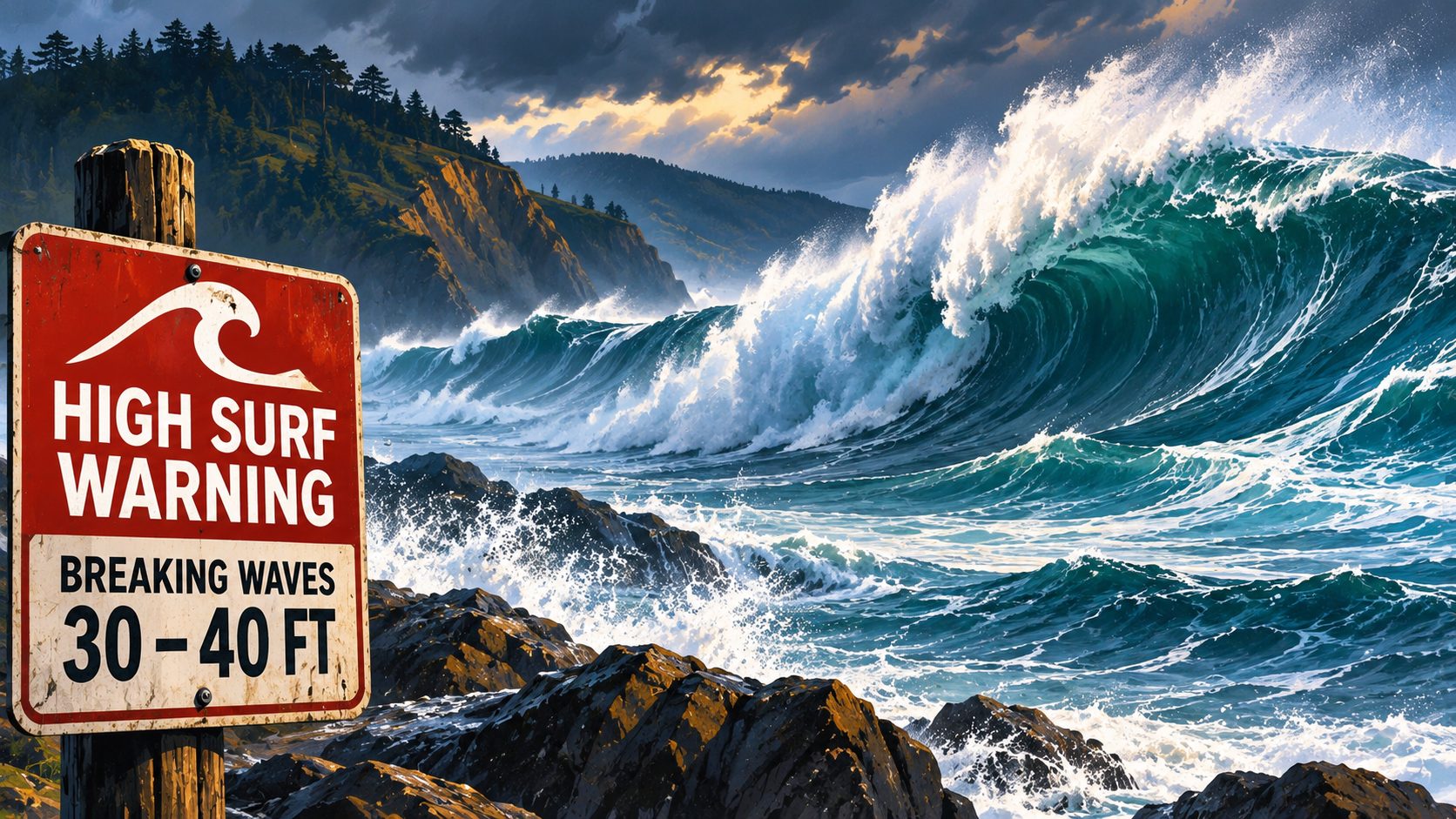
Painted illustration of huge waves crashing against a rocky, forested coast under storm clouds, beside a sign reading High surf warning, breaking waves 30 to 40 feet.
AI-generated editorial illustration of high surf on the Northern California coast. Illustration

The National Weather Service on Friday raised its surf forecast for the far Northern California coast and widened its High Surf Warnings, as the swell first forecast earlier this week arrives. Breaking waves of 30 to 40 feet are now expected on the Del Norte coast and on the southwestern Humboldt and Mendocino coasts, up from 25 to 35 feet in Wednesday's warnings. Northern coastal Humboldt is forecast at 30 to 35 feet. The Eureka office's warnings run until 4 a.m. Sunday.

In Oregon, the Medford office expects breakers of 20 to 25 feet Friday to peak at 30 to 35 feet from late Friday afternoon through Saturday morning on the Curry County and south-central coast, with the warning in effect until 10 p.m. Saturday. The Portland office has added High Surf Warnings for the Clatsop, Tillamook and central Oregon coasts, with breakers up to 30 to 35 feet until noon Saturday and coastal flood advisories for tidal overflow. A High Surf Advisory covers the south Washington coast.

Around San Francisco and from Monterey Bay to Big Sur, warnings run until 4 a.m. Sunday, with a Coastal Flood Advisory for up to 1.5 feet of inundation in low-lying areas near the shore. Farther south, the Los Angeles/Oxnard office has issued a High Surf Warning for San Luis Obispo County beaches and Santa Barbara County's Central Coast beaches for dangerously large breaking waves of at least 18 feet, until 3 a.m. Sunday. Advisories cover Ventura and Los Angeles County beaches through Tuesday afternoon, and Orange and San Diego County beaches, where sets could reach 8 to 9 feet at west-facing spots, until 10 a.m. Sunday.

Eureka forecasters said Wednesday that a second large swell is expected late Sunday through Monday.

Waves of this size can sweep people off jetties, rocks and beaches without warning. Check the warning for your stretch of coast and watch from well above the reach of the water.

Sources

notice Recall: Sharper Image Tabletop and Tabletop Infinity Fire Pits (Allstar)NationwideAbout 265,000 sold Jan 2023–Jun 2026; stop using and register for a full refundchecked Nov 13

Gear

265,000 Sharper Image Tabletop Fire Pits Recalled After Severe Burns

Burning fuel can escape the pit or flame can jet from the fuel container; four people were injured, some with fourth-degree burns.

Allstar is recalling about 265,000 Sharper Image Tabletop Fire Pits and Tabletop Infinity Fire Pits because ignited fuel can escape the pit or cause flame jetting from the fuel container, the U.S. Consumer Product Safety Commission said. The company knows of four incidents with injuries, including third- and fourth-degree burns to multiple parts of the body, KIRO 7 reports.

The pits were sold from January 2023 through June 2026 at Ace Hardware, Burlington, Home Depot, Lowe's, Kohl's, Marshalls, Nordstrom, Rite Aid, Target, TJ Maxx, Walgreens, Walmart and other stores nationwide, and online at Amazon.com and HSN.com.

Recalled pits have a "77" logo on the front and a lot code sticker in the center of the base, and a round black sticker marked "CHINA" with a five-digit code, the letters KS-CY or KS-FC, and a date code.

Owners should stop using the pits and register at firepitrecall.expertinquiry.com for a full refund. Allstar asks owners to write "RECALLED – DO NOT USE" on the pit in permanent marker and submit three photos, then, once registration is confirmed, dispose of leftover fuel under local hazardous-waste rules and throw the pit away.

Tabletop pits that burn gel or alcohol fuel can flare when fuel is added near a flame. Let any burner cool fully before refueling.

Sources

Gear

Snow Peak Reports Customer Data Breaches in Four Japanese Online Services

Snow Peak, the Japanese camping gear maker, said Friday that hackers reached customer data through several of its online services in Japan between late October and November 9. Information on up to 24,948 customers of its gear buy-back service may have leaked, including names, addresses, birth dates, phone numbers and bank account details for payouts, though not passwords, PINs or card numbers; event-booking data on 5,923 people and profile data on 21,553 community-app users were also exposed. Up to 445 accounts on its official Japanese online store and member app were logged into with credentials apparently stolen elsewhere, which could have shown partial card numbers. The company said the online store reopens Friday with stronger login checks and that it will contact affected customers; its notice covers its Japanese services and does not mention customers of Snow Peak's U.S. store.

Sources